|

Cancer Update from
Johns Hopkins:
1.
Every person has
cancer cells
in the body. These
cancer cells do not
show up in the
standard tests until
they have multiplied
to a few billion.
When doctors tell
cancer patients that
there are no
more cancer cells
in their bodies
after treatment, it
just means the tests
are unable to detect
the cancer cells
because they have
not reached the
detectable size.
2.
Cancer cells occur
between 6 to more
than 10 times in a
person's lifetime.
3.
When the person's
immune system is
strong the cancer
cells will be
destroyed and
prevented from
multiplying and
forming tumors.
4.
When a person has
cancer it indicates
the person has nutritional
deficiencies.
These could be due
to genetic, but also
to environmental,
food and lifestyle
factors.
5.
To overcome the
multiple nutritional
deficiencies,
changing diet to eat
more adequately and
healthy, 4-5
times/day and by
including
supplements will
strengthen the
immune system.
6.
Chemotherapy
involves poisoning
the
rapidly-growing cancer
cells and also
destroys
rapidly-growing
healthy cells in the
bone marrow,
gastrointestinal
tract etc,
and can cause organ
damage, like liver,
kidneys, heart,
lungs etc.
7.
Radiation while
destroying cancer
cells also burns,
scars and damages
healthy cells,
tissues and organs.
8.
Initial treatment
with chemotherapy
and radiation will
often reduce tumor
size. However
prolonged use of
chemotherapy and
radiation do not
result in more tumor
destruction.
9.
When the body has
too much toxic
burden from
chemotherapy and
radiation the immune
system is
either compromised
or destroyed, hence
the person can
succumb to various
kinds of infections
and complications.
10.
Chemotherapy and
radiation can cause
cancer cells to
mutate and become
resistant and
difficult to
destroy. Surgery can
also cause cancer
cells to spread to
other sites.
11.
An effective way to
battle cancer is to
starve the cancer
cells by not feeding
it with the foods it
needs to multiply.
a.
Sugar substitutes
like
NutraSweet,
Equal, Spoonful, etc
are made with
Aspartame and it is
harmful. A better
natural substitute
would be Manuka
honey or molasses,
but only in very
small amounts. Table
salt has a chemical
added to make it
white in color
Better alternative
is Bragg's aminos or
sea salt.
b.
Milk causes the body
to produce mucus,
especially in the
gastro-intestinal
tract. Cancer feeds
on mucus. By
cutting off milk and
substituting with
unsweetened soy
milk, cancer cells
are being starved.
c.
Cancer cells thrive
in an acid
environment. A
meat-based diet is
acidic and it is
best to eat fish,
and a little other
meat, like chicken.
Meat also contains
livestock
antibiotics,
growth hormones and
parasites, which are
all harmful,
especially to people
with cancer.
d. A
diet made of 80%
fresh vegetables and
juice, whole grains,
seeds, nuts and a
little fruits help
put the body into an
alkaline
environment. About
20% can be from
cooked food
including beans.
Fresh vegetable
juices
provide live enzymes
that are easily
absorbed and reach
down to cellular
levels within 15
minutes to nourish
and enhance growth
of healthy cells. To
obtain live enzymes
for building healthy
cells try and drink
fresh vegetable
juice
(most vegetables
including bean
sprouts) and eat
some raw vegetables
2 or 3 times a day.
Enzymes are
destroyed
at temperatures of
104 degrees F (40
degrees C).
e.
Avoid coffee, tea,
and chocolate, which
have high caffeine
Green tea is a
better alternative
and has
cancer fighting
properties.
Water-best to drink
purified water,
or filtered, to
avoid known toxins
and heavy metals in
tap water.
Distilled water
is acidic, avoid it.
(Keith's note: so is
reverse osmosis
water - down around
5.0 pH, DON'T drink
it any more! Kangen
Water is purified,
heavy-metal free, a
powerful
anti-oxidant,
alkaline, ionized,
restructured, and
delicious. Call me
for your FREE 3-week
trial!)
12. Meat protein is
difficult to digest
and requires a lot
of
digestive enzymes.
Undigested meat
remaining in the
intestines becomes
putrefied and leads
to more toxic
buildup.
13.
Cancer cell walls
have a tough protein
covering.
By refraining from
or eating less meat
it frees more
enzymes to attack
the protein walls of
cancer cells and
allows the body's
killer cells to
destroy the cancer
cells.
14.
Some supplements
build up the immune
system (IP6,
Flor-ssence, Essiac,
anti-oxidants,
vitamins, minerals, EFAs
etc.) to enable the
bodies own killer
cells to
destroy cancer
cells.. Other
supplements like
vitamin E are
known to cause
apoptosis, or
programmed cell
death, the
body's normal method
of disposing of
damaged, unwanted,
or unneeded cells.
15.
Cancer is a disease
of the mind, body,
and spirit. A
proactive and
positive spirit will
help the cancer
warrior be a
survivor. Anger,
un-forgiveness and
bitterness put the
body into a
stressful and acidic
environment. Learn
to have a loving and
forgiving spirit.
Learn to relax and
enjoy life.
16.
Cancer cells cannot
thrive in an
oxygenated environment.
Exercising daily,
and deep breathing
help to get more
oxygen down to the
cellular level.
Oxygen therapy is
another means
employed to destroy
cancer cells.
(Keith's Note:
Kangen Water helps
get more oxygen into
your cells more
efficiently than
anything else. Call
me and I'll explain
how and why.)
1.
No
plastic containers
in micro.
2.
No water bottles in
freezer.
3.
No plastic wrap in
microwave..
Johns Hopkins has
recently sent this
out in its
newsletters. This
information is being
circulated at Walter
Reed Army Medical
Center as well.
Dioxin chemicals
cause cancer,
especially
breast cancer.
Dioxins are
highly poisonous to
the cells of our
bodies. Don't freeze
your
plastic bottles
with water in them
as this releases
dioxins from the
plastic. Recently,
Dr Edward Fujimoto,
Wellness Program
Manager at Castle
Hospital , was on a
TV program to
explain this
health hazard.
He talked about
dioxins and how bad
they are for us. He
said that we should
not be heating our
food in the
microwave using
plastic containers.
This especially
applies to foods
that contain fat.
He
said that the
combination of fat,
high heat, and
plastics releases
dioxin
into the food and
ultimately into the
cells of the body.
Instead, he
recommends using
glass, such as
Corning Ware,
Pyrex or
ceramic containers
for heating food.
You get the same
results, only
without the dioxin.
So such things as
TV dinners,
instant ramen and
soups, etc., should
be removed from the
container and heated
in something else.
Paper isn't bad but
you don't know what
is in the paper.
It's just safer to
use tempered glass,
Corning Ware, etc.
He reminded us that
a while ago some of
the fast food
restaurants moved
away from the foam
containers to paper
The dioxin problem
is one of the
reasons.
Please share this
with your whole
email
list.........................
Also, he pointed out
that plastic wrap,
such as Saran, is
just as dangerous
when placed over
foods to be cooked
in the microwave. As
the food is nuked,
the high heat causes
poisonous toxins to
actually melt out of
the plastic
wrap and drip into
the food. Cover food
with a paper towel
instead.
This
is an article that
should be sent to
anyone important in
your life.
|
EarthTalk®
From the Editors of E/The Environmental Magazine
 Dear
EarthTalk:
I've noticed that wildflower blooms
in the mountains have been coming earlier and earlier in recent
years. Is this a sign of global warming? And what does this mean
for the long term survival of these hardy yet rare plants?
-- Ashley J., via e-mail Dear
EarthTalk:
I've noticed that wildflower blooms
in the mountains have been coming earlier and earlier in recent
years. Is this a sign of global warming? And what does this mean
for the long term survival of these hardy yet rare plants?
-- Ashley J., via e-mail
As always, it’s hard to pin specific year-to-year
weather-variations and related phenomena—including altered
blooming schedules for wildflowers—on global warming. But longer
term analysis of seasonal flowering patterns and other natural
events do indicate that global warming may be playing a role in
how early wildflowers begin popping up in the high country.
University
of Maryland ecologist David Inouye has been studying wildflowers
in the Rocky Mountains near Crested Butte, Colorado for four
decades, and has noticed that blooms have indeed begun earlier
over the last decade. Aspen sunflowers, among other charismatic
high country wildflowers, used to first bloom in mid-May, but
are now are doing so in mid-April, a full month earlier. Inouye
thinks that smaller snow packs in the mountains are melting
earlier due to global warming, in turn triggering early blooms.
Smaller snow packs not only mean fewer flowers (since they have
less water to use in photosynthesis); they can also stress
wildflower populations not accustomed to exposure to late-spring
frost. According to Inouye’s research, between 1992 and 1998
such frosts killed about a third of the Aspen sunflower buds in
some 30 different study plots; but more recently, from 1999
through 2006, the typical mortality rate doubled, with
three-quarters of all buds killed by frost in an average year
thanks to earlier blooming.
Inouye’s worrisome conclusions are backed up by experiments
conducted by fellow researcher John Harte, who over a 15 year
period used overhead heaters in nearby wildflower study plots to
accelerate snow melt. The results were the same: Wildflowers
bloomed early and not as vigorously.
Several studies in Europe have shown that some species of
wildflowers there may be able to migrate north and to higher
elevations as the climate warms, but Inouye fears his beloved
Aspen sunflowers and many other American wildflowers may be lost
forever as they are not able to migrate as quickly as needed in
order to survive widespread surface temperature increases and
escape extinction.
Harte is also gloomy about the prospects for Colorado’s
mountain wildflowers. He predicts that the wildflower fields he
and Inouye have been studying will give way to sagebrush desert
within the next 50 years, whether or not the governments of the
world can get a grip on greenhouse gas emissions.
As a hedge against such dire predictions, the nonprofit Center
for Plant Conservation is spearheading seed collection efforts
on thousands of rare wildflower species across the U.S. for
inclusion in the Colorado-based National Center for Genetic
Resources Preservation, a repository for both common and rare
“prized” American plant seeds. The “banked” seeds, useful if not
solely for preserving the genetic makeup of species that may go
extinct in the wild, can also be used for future restoration
projects on otherwise compromised landscapes.
CONTACTS:
David W. Inouye,
http://chemlife.umd.edu/facultyresearch/facultydirectory/davidwinouye;
Center for Plant Conservation,
www.centerforplantconservation.org;
National Center for Genetic Resources Preservation,
www.ars.usda.gov/main/site_main.htm?modecode=54-02-05-00.
 Dear
EarthTalk: What are the most important foods to buy organic?-- Rachel Klepping, Bronxville, NY Dear
EarthTalk: What are the most important foods to buy organic?-- Rachel Klepping, Bronxville, NY
Given the usual higher prices of organic versus
conventionally-grown foods, it can be a challenge to get the
biggest bang for our buck while eating healthy and avoiding the
ingestion of synthetic chemicals along with our nutrients. One
approach, say some experts, is to only buy organic when the
actual edible parts of a non-organically grown food might come
into direct contact with toxic fertilizers and pesticides.
The nonprofit Environmental Working Group (EWG) reports that
consumers can reduce their chemical exposure by some 80 percent
by either avoiding the most contaminated conventionally grown
fruits and vegetables altogether, or by eating only the organic
varieties. To help us sort through what and what not to buy, the
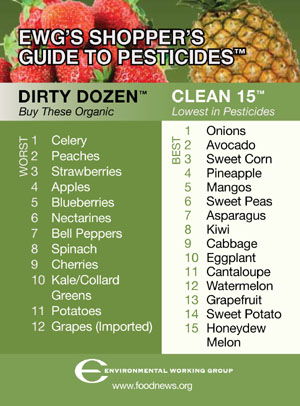
group offers a handy Shopper’s Guide to Pesticides, which
fits on a small piece of paper that you can keep in your pocket
and have handy on grocery trips. You can print it out for free
from EWG’s FoodNews.org website, or you can download it as a
free App for your iPhone.
To make it easy to use, EWG has distilled its analysis into two
lists. The first, “Dirty Dozen: Buy These Organic,” lists foods
that when grown conventionally contain the largest amounts of
pesticide and fertilizer residues. These include peaches,
strawberries, apples, blueberries, nectarines, bell peppers,
spinach, cherries, kale/collard, greens, potatoes, and
(imported) grapes. Consumers should definitely spend the extra
money for organic versions of these foods.
On the other side of the coin, EWG’s “Clean 15” list includes
foods that contain the least amount of chemical residues when
grown conventionally. These include
onions, avocados, sweet corn, pineapples, mangos, sweet peas,
asparagus, kiwi, cabbage, eggplant, cantaloupe, watermelon,
grapefruit, sweet potatoes and honeydew. It’s OK to eat
conventionally grown varieties of these foods.
EWG
analysts developed the “Clean 15” guide using data from some
89,000 tests for pesticide residues in produce conducted between
2000 and 2008 and collected by the U.S. Department of
Agriculture (USDA) and the U.S. Food and Drug Administration
(FDA). What’s the difference, you may ask? EWG found that by
eating five conventionally-grown fruits and vegetables a day
from the Dirty Dozen list, a consumer on average ingests 10
different pesticides; those who stick to the Clean 15 list
ingest less than two.
Other foods you and your family eat, such as meats, cereals,
breads and dairy products, might also be exposing you to
unwanted chemicals. According to EWG, the direct health benefits
of organic meat, eggs and milk are less clear, but you should
play it safe by sticking with all-natural, free-range, grass-fed
meats that are not fed antibiotics or growth hormones, and by
choosing only organic dairy products.
Thanks to increasing demand, more and more food purveyors are
putting extra emphasis on organics. This will ultimately result
in both lower prices and larger selections. Natural foods market
aisles are already teeming with organic choices—and chances are
your local supermarket or big box store has introduced organic
versions of many popular items. Consequently, there has never
been a better time to take stock of what you are feeding
yourself and your family, and to make changes for better health.
CONTACT:
EWG,
www.foodnews.org;
USDA/FDA, http://usda-fda.com/articles/organic.htm.
SEND
YOUR ENVIRONMENTAL QUESTIONS TO:
EarthTalk®, c/o E – The Environmental Magazine,
P.O. Box 5098, Westport, CT 06881; earthtalk@emagazine.com.
E is a nonprofit publication. Subscribe:
www.emagazine.com/subscribe;
Request a Free Trial Issue:
www.emagazine.com/trial
EarthTalk®
From the Editors of E/The Environmental Magazine
 Dear
EarthTalk:
I heard that some wind farms
use fossil fuels to power their generators when the wind won’t.
Doesn’t that defeat their whole renewable energy purpose? Why
not let the wind power it or not? Also, I've heard that the
low-frequency sounds generated by these turbines can harm people
and animals. Is this true?
-- Ryan Lewis, Plainwell, MI Dear
EarthTalk:
I heard that some wind farms
use fossil fuels to power their generators when the wind won’t.
Doesn’t that defeat their whole renewable energy purpose? Why
not let the wind power it or not? Also, I've heard that the
low-frequency sounds generated by these turbines can harm people
and animals. Is this true?
-- Ryan Lewis, Plainwell, MI
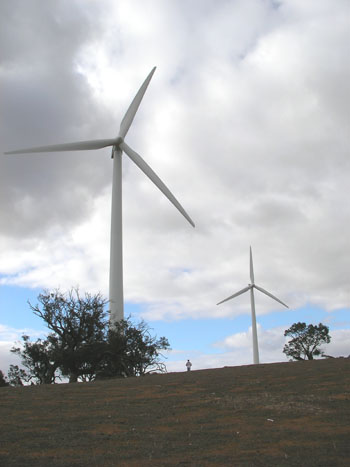
Indeed, one of the major drawbacks to wind power
is the fact that, even in windy locations, the wind doesn’t
always blow. So the ability of turbines to generate power is
intermittent at best. Many turbines can generate power only
about 30 percent of the time, thanks to the inconsistency of
their feedstock.
In order to overcome this Achilles’ heel of
intermittent production, some wind companies have developed
back-up systems that can spin turbines even when the wind isn’t
blowing, thus optimizing and keeping consistent the power
output. For example, Colorado-based Hybrid Turbines Inc. is
selling wind farms systems that marry a natural gas-based
generator to a wind turbine. “Even if natural gas is used, the
electricity produced…is twice as environmentally clean as
burning coal,” reports the company. Better yet, if a user can
power them with plant-derived biofuels, they can remain 100
percent renewable energy-based.
While some wind energy companies may want to
invest in such technologies to wring the most production out of
their big investments, utilities aren’t likely to suffer much
from the intermittent output if they don’t. Even the utilities
that are most bullish on wind power still generate most of their
electricity from other more traditional sources at the present
time. So, when wind energy output decreases, utilities simply
draw more power from other sources—such as solar arrays,
hydroelectric dams, nuclear reactors and coal-fired power
plants—to maintain consistent electrical service. As such,
reports the American Wind Energy Association, utilities act as
“system operators” drawing power from where it’s available and
dispatching it to where it is needed in tune with rising and
falling power needs.
But just because generating wind power all day
long isn’t imperative doesn’t mean that suppliers aren’t doing
all they can to maximize output. To wit, turbine manufacturers
are beginning to incorporate so-called Active Flow Control (AFC)
technology, which delays the occurrence of partial or complete
stalls when the wind dies down, and also enables start-up and
power generation at lower wind speeds than conventional
turbines. The non-profit Union of Concerned Scientists lauds AFC
for these capabilities, which in turn can help system operators
create a more reliable electric grid less dependent on fossil
fuels.
As to whether or not noise from wind farms can
harm people and wildlife, the jury is still out. New York-based
pediatrician Nina Pierpont argues in her book, Wind Turbine
Syndrome, that turbines may produce sounds that can affect
the mood of people nearby or cause physiological problems like
insomnia, vertigo, headaches and nausea. On the flip side,
Renewable UK, a British wind energy trade group, says that the
noise measured 1,000 feet away from a wind farm is less than
that of normal road traffic. Here in the U.S., a Texas jury
denied a 2006 noise pollution suit against FPL Energy after FPL
showed that noise readings from its wind farm maxed out at 44
decibels, roughly the same generated by a 10 mile-per-hour
wind.
CONTACTS:
Hybrid Turbines, Inc., www.hybridturbines.com; American Wind
Energy Association, www.awea.org; Union of Concerned Scientists,
www.ucsusa.org; Nina Pierpont’s Wind Turbine Syndrome,
www.windturbinesyndrome.com.
SEND
YOUR ENVIRONMENTAL QUESTIONS TO:
EarthTalk®, c/o E – The Environmental Magazine,
P.O. Box 5098, Westport, CT 06881; earthtalk@emagazine.com.
E is a nonprofit publication. Subscribe:
www.emagazine.com/subscribe;
Request a Free Trial Issue:
www.emagazine.com/trial.
EarthTalk®
From the Editors of E/The Environmental Magazine
 Dear
EarthTalk:
My neighbor told me to pour
bleach down my drains every week to keep them clear. Is this
safe to do?
-- Trish Osterling, via e-mail Dear
EarthTalk:
My neighbor told me to pour
bleach down my drains every week to keep them clear. Is this
safe to do?
-- Trish Osterling, via e-mail
Bleach is a useful cleaner and disinfectant, but
pouring it down the drain will not do anything to help keep the
drains clear. In addition, you could cause a dangerous chemical
reaction if it comes into contact with other household products
you might be using.
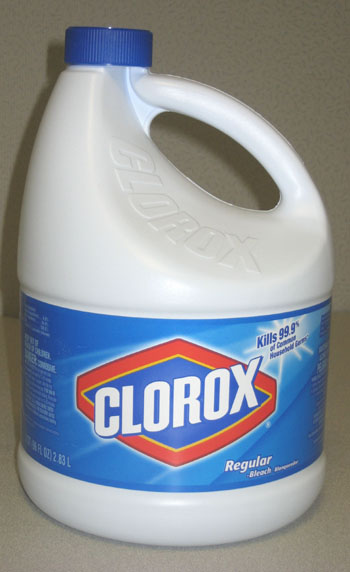
Common household bleach, also known as chlorine
bleach, is a liquid compound of sodium hypochlorite, which is a
combination of sodium chloride (a salt) with water and chlorine.
It’s often used to whiten laundry or to disinfect kitchen
surfaces. Bleach is also an ingredient in other household
cleaners, like those used for bath and toilet cleaning. (A
different sort of bleach, known as oxygen bleach, is used for
laundry stain removal and does not have the same
disinfecting/cleaning properties as chlorine bleach.)
According to the Household Products Database at
the U.S. Department of Health and Human Services (DHHS),
chlorine bleach is corrosive to the eyes; injures skin and
mucous membranes on contact; and is harmful if swallowed. Bleach
is “a lung and eye irritant,” warns the Washington Toxics
Coalition (WTC), a Seattle non-profit that advocates for green
friendly household products. Even used alone, fumes from
chlorine bleach can irritate the lungs, so it should not be used
by people with asthma or lung or heart problems, says the group.
It is also “reactive” with ammonia and acids, forming more
harmful fumes.
“One of the most common home accidents is the
mixing of products containing chlorine bleach with those
containing ammonia,” says WTC. The combination creates
chloramine gas, which is highly irritating to the lungs. Since
many cleaning products contain ammonia, the inadvertent mixing
must be avoided. Mixing bleach and acids results in the release
of chlorine gas, according to the New Jersey Department of
Health and Senior Services, exposure to which can cause coughing
and breathing problems, burning eyes and, at high levels,
vomiting, pneumonia and even death. Products containing acids
include vinegar, some glass and window cleaners, toilet bowl
cleaners, drain cleaners and rust removers. An “incompatibility
chart” listing many chemicals that will react with bleach is
available at the Chlorine Institute’s cl2.com website.
Bleach alone is not necessarily hard on the
environment. When use as directed, it will break down mostly
into salt water in wastewater treatment or septic systems, says
WTC. A dilution of bleach in water is effective as a
disinfectant, and can be scrubbed onto non-porous food-contact
surfaces like plastic cutting boards or refrigerator shelves and
left to air dry. The Clorox Company recommends a solution of one
tablespoon bleach per gallon of water for sanitizing.
So, what are the better ways to keep drains
clear? Home drains in the kitchen and bath generally get clogged
by grease, food waste and hair, none of which will be
effectively dispersed by bleach. WTC recommends carefully
pouring a kettleful of boiling water down the drain to free up a
slow drain, or using mechanical methods such as a plumber’s
snake, plunger or hose-end bladder to clean a clogged drain.
CONTACTS:
DHHS Household Products Database,
http://hpd.nlm.nih.gov ;
Washington Toxics Coalition, www.washingtontoxics.org; New
Jersey Department of Health and Senior Services, www.state.nj.us/health;
Chlorine Institute, www.cl2.com.
SEND
YOUR ENVIRONMENTAL QUESTIONS TO:
EarthTalk®, c/o E – The Environmental Magazine,
P.O. Box 5098, Westport, CT 06881; earthtalk@emagazine.com.
E is a nonprofit publication. Subscribe:
www.emagazine.com/subscribe;
Request a Free Trial Issue:
www.emagazine.com/trial.
From the Editors of E/The
Environmental Magazine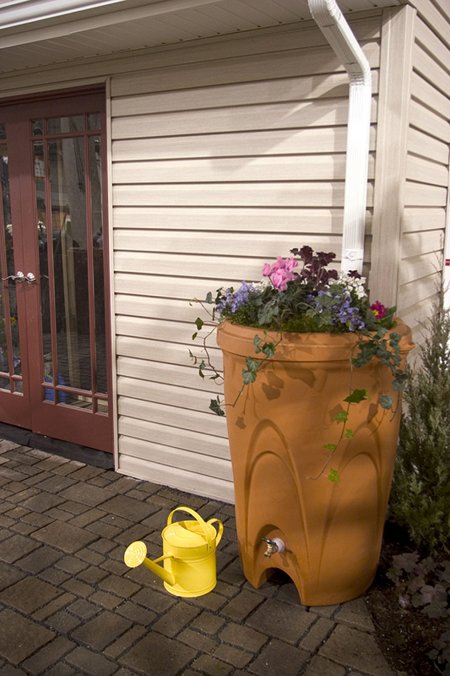
Dear
EarthTalk How can I make good use of the rainwater that runs
down my roof and into my gutters?
-- Brian Smith, Nashua, NH
For most of us, the rain that falls
on our roof runs off into the ground
or the sewer system. But if you’re
motivated to save a little water and
re-distribute it on your lawns or
plants—or even use it for laundry,
dishes or other interior
needs—collecting rainwater from your
gutters’ downspouts is a no-brainer.
If it’s allowed in your state, that
is. Utah and parts of Washington
State have antiquated but
nonetheless tough laws banning
anyone but owners of water rights
from collecting rainwater flowing
off privately owned rooftops. Such
laws are rarely enforced, however,
and one in Colorado was recently
overturned.
According to John C. Davis, writing
in E – The Environmental Magazine,
just about any homeowner can collect
rainwater, given that the roof and
gutters do most of the work. And
since an inch of rain falling on a
2,000-square-foot roof produces some
1,200 gallons of runoff, one can
harvest enough to supply all the
water needs of a family of four for
about two weeks. Of course, most of
us would only use rainwater to
irrigate our lawn or garden, and
there should be plenty to go around
for doing that in all but the most
drought stricken areas.
Plants and grass actually do better
when fed rainwater instead of tap
water, which is usually treated with
softeners that actually inhibit
plant growth. And, reports Davis,
the lack of minerals in rainwater
actually makes it more effective
than tap water for shampooing or
doing dishes. Using rainwater for
plumbing uses can also extend the
life of pipes and water heaters,
since the salts added to tap water
facilitate corrosion. Homeowners
should set up a water purification
system if they do plan to use
rainwater for interior needs.
Beyond the benefits to individual
homeowners, rainwater harvesting can
also be good for the local
community, as it reduces the
erosion, flooding and pollution
runoff associated with heavy
rainfall, and lessens reliance on
public water supplies, alleviating
some of the burden on utilities.
Given these benefits, some states,
including even drought-prone Texas,
subsidize residential rainwater
collection systems.
Many varieties of rain barrel
systems, starting at just $100, are
available for home installation. A
typical set-up is simply a rain
barrel positioned under a gutter’s
downspout. “The barrel is typically
fitted with a spigot at its base to
fill a watering can or attach a
soaker hose (which bleeds out water
all along its length, providing
effortless drip irrigation), and a
filter or screen at its top to
prevent a buildup of leaves and
other debris,” writes Davis.
According to the U.S. Environmental
Protection Agency, a single 100
gallon rain barrel can save up to
1,300 gallons of utility-provided
water during the high demand summer
months.
Handy homeowners can make their own
water harvesting systems, but buying
one pre-made is a lot easier. Most
nurseries and garden centers offer a
range of choices (as well as
advice), but websites such as
Aquabarrel, Clean Air Gardening and
Rainxchange make it easy to order a
system online.
CONTACTS:
Aquabarrel,
www.aquabarrel.com, Clean
Air Gardening,
www.cleanairgardening.com;
Rainxchange,
www.rainxchange.com.
SEND YOUR ENVIRONMENTAL QUESTIONS
TO:
EarthTalk®, P.O.
Box 5098, Westport, CT 06881;
earthtalk@emagazine.com. Read past
columns at: www.emagazine.com/earthtalk/archives.php.
EarthTalk® is now
a book! Details and order
information at: www.emagazine.com/earthtalkbook.
 EarthTalk® EarthTalk®
From the Editors of E/The
Environmental Magazine
Dear
EarthTalk: I heard that goats are being used to prevent some of
those catastrophic fires that seem
to happen increasingly. What’s the
story with that?
-- Ali B., New
Canaan, CT
As wildfires consume parts of
California larger than some smaller
states, everyone is talking about
how we can prevent such disasters
from getting going in the first
place. One novel approach is to
enlist goats. Not as
firefighters—although their
surefootedness and determination
would probably serve them well in
such situations—but as grazers to
keep the forest underbrush clear of
the tinder-like grasses, bushes and
small trees that allow flames to
jump to the higher forest canopy and
get further spread by the wind.
“Goats help prevent forest fires…by
eating the dry stuff before the fire
season strikes,” says Lani Malmberg,
owner of Colorado-based Ewe4ic
(pronounced “u-for-ik”) Ecological
Services, which uses goats to
gradually and naturally remove weeds
and return lands to a healthier more
natural state.
Goats have been called in for fire
mitigation purposes across parts of
California, Arizona and other
drought-prone parts of the western
U.S. In the Oakland and Berkeley
hills regions of California’s Bay
Area, where the combined effects of
drought and a bark beetle
infestation have killed thousands of
acres of trees, public agencies and
residents have enlisted the help of
goat herds to suppress weeds and
keep down the fire risk in the
process for what remains of the
area’s forest cover.
“The goat clearance scheme is one
of the key reasons the Bay Area
hasn’t had a recurrence of a
catastrophic fire in decades,” says
Tom Klatt, former manager of the
Office of Emergency Preparedness at
UC Berkeley and the author of UC
Berkeley's 2007 Fire Mitigation
Program Annual Report.
Other earth-minded land managers
are going goat as well. The Nature
Conservancy recently hired goats to
keep dry grasses and other
tinder-like plant matter down at its
Hassayampa River Preserve in
Arizona, where the constant threat
of summer fires haunts nearby
homeowners while endangering the
integrity of the area’s unique and
fragile riparian ecosystem.
Using goats to control forest brush
may seem like a novel idea, but it’s
really been around as long as
grazing animals have roamed the
planet looking for nourishment. But
with ever-increasing human
development, wild grazers are fewer
and farther between. The problem is
exacerbated by our building our
homes so close to (and sometimes
within) forested areas that
naturally burn occasionally. Efforts
to then suppress all forest
fires—even naturally occurring
undergrowth burns—to protect these
homes have led to “tinderbox”
conditions ripe for those large
destructive fires that spread for
hundreds of miles, blown by the wind
from treetop to treetop.
Grazing goats are also used in
other endeavors. “Goats can be
utilized as an effective bio-control
agent to reduce weed populations to
economically acceptable levels,”
says Malmberg, adding that weeding
with goats requires no pesticides or
herbicides and generates zero
greenhouse gas or other harmful
emissions.
CONTACTS:
Ewe4ic Ecological Services,
www.goatseatweeds.com; Office of
Emergency Preparedness at UC
Berkeley, oep.berkeley.edu.
SEND
YOUR ENVIRONMENTAL QUESTIONS TO:
EarthTalk®, P.O.
Box 5098, Westport, CT 06881;
earthtalk@emagazine.com. Read past
columns at: www.emagazine.com/earthtalk/archives.php.
EarthTalk® is now
a book! Details and order
information at: www.emagazine.com/earthtalkbook.
EarthTalk®
From the Editors of E/The
Environmental Magazine
Dear EarthTalk:
Has
China been making any progress
reducing its output of global
warming gases, and/or in tackling
other environmental problems?
–Bill W.,
Saugus, MA
Decades of
rapid-fire development and lack of
government oversight has meant that
China now faces some serious
environmental challenges. According
to research by the Netherlands
Environmental Assessment Agency,
China surpassed the United States as
the world’s leading emitter of
greenhouse gases in 2006—and hasn’t
looked back. (While the Chinese emit
some eight percent more carbon
dioxide than their American
counterparts, the U.S. still leads
the world in greenhouse gas
emissions per capita, due to its
significantly smaller population
size and higher standard of living.)
Beyond its
contribution to global warming,
China is also a world leader in
other forms of pollution, given its
huge population and its ambition to
become the next international
economic superpower. According to
the World Health Organization (WHO),
current levels of air pollution in
China far exceed international
environmental standards. A recent
analysis found, for example, that
the air in some four dozen Chinese
cities contained as much as seven
times as much particulate
pollution—which can get lodged in
human lungs and cause a wide range
of health problems—as deemed safe by
WHO.
But critics say
blaming China for its rampant
pollution is unfair, given all the
manufacturing the world’s developed
countries outsource to Chinese
companies. Qin Gang, China’s foreign
ministry spokesman, refers to China
as the “world’s factory” and says:
“A lot of what you use, wear and eat
is produced in China… “On the one
hand, you increase production in
China; on the other hand you
criticize China on the emission
reduction issue.” Yang Ailun of
Greenpeace China agrees: “All the
West has done is export a great
slice of its carbon footprint to
China and make China the world’s
factory.”
Despite its efforts
to go green, China still depends on
coal—the dirtiest of all the fossil
fuels—for some two-thirds of its
energy needs. Chinese officials have
strenuously opposed the binding
limits on greenhouse gas emissions
set by developing countries, arguing
that already industrialized nations
are to blame for most of the
emissions already in the atmosphere.
According to Isabel
Hilton, a journalist with the UK’s
Guardian, industrialized
countries should feel an obligation
to shoulder at least some of the
burden of helping China become a
greener nation. “This means
drastically reducing our own
emissions and helping China with the
finance and technology required to
move to a sustainable, low-carbon
economic system.”
There is progress
afoot: Meetings between top Chinese
and U.S. officials earlier this year
led to the creation of a joint
research center to address issues
related to clean energy, with each
country contributing $15 million to
pay for initial research efforts.
CONTACTS:
Netherlands Environmental Assessment
Agency,
www.pbl.nl; World Health
Organization,
www.who.int; Greenpeace China,
www.greenpeace.org/china.
SEND
YOUR ENVIRONMENTAL QUESTIONS TO:
EarthTalk®,
P.O. Box 5098, Westport, CT
06881; earthtalk@emagazine.com. Read
past columns at: www.emagazine.com/earthtalk/archives.php.
EarthTalk®
is now a book! Details and order
information at:
www.emagazine.com/earthtalkbook.
EarthTalk®
From the Editors of E/The
Environmental Magazine
 Dear
EarthTalk:
What are the pros and cons of
feeding
babies formula versus breast
milk? And if I purchase formula,
should I spend the extra money on
the organic variety?
-- Suzy W.,
via e-mail Dear
EarthTalk:
What are the pros and cons of
feeding
babies formula versus breast
milk? And if I purchase formula,
should I spend the extra money on
the organic variety?
-- Suzy W.,
via e-mail
It is generally
acknowledged within the medical
community that breast milk is the
ideal first food for babies, though
modern formula brands can get the
job done, too. Human breast milk
naturally contains the vitamins and
minerals a newborn requires.
According to the website
KidsHealth.org, breastfed infants
have less difficulty with digestion
than their formula-fed counterparts.
And since breast milk is easily
digested, breastfed babies have
fewer incidences of diarrhea or
constipation.
Also, researchers
have found that infants fed with
human breast milk have lower rates
of hospital admissions, ear
infections, diarrhea, rashes and
allergies than bottle-fed babies.
Meanwhile, a raft of studies suggest
that infants who are fed breast milk
may have lower incidences of asthma,
diabetes, obesity and other health
problems later on in life.
“Human milk is made
for human infants, and it meets all
their specific nutrient needs,” says
Ruth Lawrence, M.D., spokeswoman for
the American Academy of Pediatrics
and professor of pediatrics and
obstetrics at the University of
Rochester School of Medicine in New
York. “We’ve known for years that
the death rates in Third World
countries are lower among breast-fed
babies,” she adds. “Breast-fed
babies are healthier and have fewer
infections than formula-fed babies.”
Another related
upside to breast milk is cost
savings—both for families and the
larger health care system. Mothers
who can’t or choose not to breast
feed end up spending hundreds if not
thousands of dollars per year on
formula, and higher incidences of
illness and disease down the road
means higher costs for all.
One concern with
breast feeding is that toxins
present in mom’s bloodstream can
make their way into baby. But a 2007
study by Ohio State and Johns
Hopkins University researchers found
that levels of chemicals in breast
milk were far below U.S.
Environmental Protection Agency
maximum acceptable levels for even
drinking water, and that indoor air
in typical American homes contains
as much as 135 times as many
contaminants as mother’s milk. The
U.S. Centers for Disease Control
maintains that the benefits of
breastfeeding far outweigh any
chemical exposure risks. “To date,
effects on the nursing infant have
been seen only where the mother
herself was clinically ill from a
toxic exposure,” reports the agency.
Of course, not all
mothers are able to breastfeed, and
in such cases formula can be a
healthy alternative. The U.S. Food
and Drug Administration regulates
all baby formulas to ensure purity
and that they meet nutritional
requirements. Parents should know,
however, that they may not be
avoiding chemical exposure by opting
for formula. Non-organic formula can
contain the same or higher amounts
of chemical residues left over from
its raw materials. One way around
this is to buy organic formula.
Leading makers include Nature’s One,
Earth’s Best and Bright Beginnings.
Enfamil and Similac also now offer
organic varieties.
CONTACTS:
Kids Health,
www.kidshealth.org; American
Academy of Pediatrics,
www.aap.org; U.S. Food and Drug
Administration,
www.fda.gov; Consumer Reports,
www.consumerreports.org.
SEND YOUR
ENVIRONMENTAL QUESTIONS TO:
EarthTalk®,
P.O. Box 5098, Westport, CT
06881; earthtalk@emagazine.com. Read
past columns at: www.emagazine.com/earthtalk/archives.php.
EarthTalk®
is now a book! Details and order
information at: www.emagazine.com/earthtalkbook. |
|
EarthTalkTM
Fro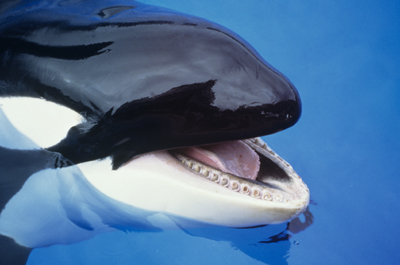 m
the Editors of E/The Environmental
Magazine m
the Editors of E/The Environmental
Magazine
Dear EarthTalk: How are populations of the world’s
orca whales
faring these days? Are we still in
danger of losing them all in the
wild?
--
J. Witham, Bangor, ME
Tom Brakefield, Getty Images
The largest member of the dolphin family and a major draw at
marine parks, orcas (also known as
“killer whales”) are highly
intelligent and social marine
mammals that, because of these
traits, have come to be known as
ambassadors for nature and marine
ecosystems around the world.
But the fact that people love orcas—most of us only ever see them
in captivity—has no bearing on how
well they are thriving in the wild.
Many of their habits are still a
mystery to science, as the great
black and white creatures, which can
grow to 26 feet and weight six tons,
are fast-moving and difficult to
track (they are the most widely
distributed mammals on Earth,
besides humans).
Given this uncertainty, the International Union for the
Conservation of Nature (IUCN), a
nonprofit group that maintains a
frequently updated global list (the
so-called “Red List”) of endangered
and threatened wildlife, merely
lists the status of orcas as “data
deficient.” IUCN is currently
involved in an assessment of orca
populations around the world to
determine what their status should
be.
Orcas may not have a clear-cut conservation status internationally,
but the U.S. government is concerned
enough about the animals that ply
the waters of Washington’s Puget
Sound and San Juan Islands (known as
the “southern residents”) to put
them on the federal endangered
species list. Chief among threats to
orcas there is loss of food supply,
mostly West Coast salmon populations
destroyed by hydroelectric dams and
other human encroachment. Habitat
loss, chemical pollution, captures
for marine mammal parks and
conflicts with fisheries have also
each played roles in the decline of
the Northwest’s orcas.
According to the National Marine Fisheries Service, an arm of the
federal National Oceanic and
Atmospheric Administration, the
southern resident orca
population—the best studied wild
animal population in the world—has
fluctuated considerably since
researchers began studying it in
earnest some three decades ago. In
1974 the group was comprised of 71
whales, but then spiked to 97
animals by 1996. But since then the
population fell below 80 and has
remained around that level ever
since.
Due to their voracious appetites and their place at the top of the
ocean food chain, orcas are very
susceptible to pollution and
chemicals and suffer from diseases
and reproductive disorders
accordingly. For this reason many
scientists consider orcas an
“indicator species” regarding the
health of marine ecosystems in
general. That is, if orcas are in
decline, the rest of the ocean is
likely in big trouble, too.
Of course, increased concern about the health of marine ecosystems
in recent years is good news for
orcas, which are dependent on a wide
range of fish and marine mammals for
sustenance. The preponderance of
protected stretches of both ocean
and coasts gives orcas a boost in
their struggle to stay one step
ahead of extinction. If world
leaders continue to value marine
ecosystems and limit the extraction
of seafood species and contamination
by pollutants, killer whales will
have a fighting chance to keep on as
icons of the sea—and those of us
onshore and bobbing on boats will
continue to be delighted and amazed
by them. CONTACTS:
IUCN, www.iucn.org; National Marine
Fisheries Service, www.nmfs.noaa.gov.
SEND
YOUR ENVIRONMENTAL QUESTIONS TO: EarthTalk, P.O. Box 5098,
Westport, CT 06881; earthtalk@emagazine.com.
Read past columns at:
www.emagazine.com/earthtalk/archives.php.
EarthTalk is now a book!
Details and order information at:
www.emagazine.com/earthtalkbook.
EarthTalkTM
From the Editors of E/The
Environmental Magazine
Dear EarthTalk: Since Obama took office, have any new
incentives been put in place for
homeowners looking to increase
energy efficiency and reduce the
overall environmental footprints of
their homes?
-- Rob Felton, Little Rock, AK In fact, yes. Homeowners can get up to $1,500 back from the federal
government for any number of energy
efficiency upgrades at home. If you
upgrade to energy efficient
insulation, windows, doors, heating,
air conditioning or water heaters
between January 1, 2009 and December
31, 2010, you are eligible for a tax
credits of up to 30 percent of
product costs.
The credit is capped at $1,500 combined; meaning it only applies to
$5,000 in total costs. More details
are available at the website of the
Tax Incentives Assistance Project, a
coalition of public interest
nonprofit groups, government
agencies and other organizations
focused on energy efficiency.
Of course, the Obama administration is also thinking long term, and
would like to leave its mark in
furthering efforts to wean ourselves
off foreign oil and increase our
production and use of homegrown
clean renewable energy. In light of
such priorities, tax credits are
also available for 30 percent of the
cost—with no upper limit—on
the installation of renewable energy
equipment at home, such as
geothermal heat pumps, solar panels,
solar hot water heaters, small wind
energy systems and fuel cells.
Homeowners won’t get the money back when they initially pay for
equipment or upgrades, but they can
add the credit amount to their
overall tax refund, or deduct it
from what they owe, when filing
their federal income tax forms at
the end of the year. Unlike tax
deductions, which merely lower
the total amount of taxable income,
tax credits reduce
dollar-for-dollar the amount of tax
owed.
Homeowners should know that they can also get federally backed
mortgages to pay for a variety of
energy efficiency measures,
including renewable energy
technologies, on their new or
existing homes. The federal
government supports these loans by
insuring them through the Federal
Housing Authority or Veterans
Affairs programs, allowing borrowers
who might otherwise not qualify to
pursue upgrades, and securing
lending institutions against loan
default.
Don’t own a home? Depending upon make and model, you can get
between $250 and $3,400 back from
the federal government for buying or
leasing a new hybrid or high
efficiency diesel automobile. And
the automakers themselves—through
their own “Automotive Stimulus
Plan”—are giving consumers up to
$4,500 back on the purchase of a new
or used vehicle that gets gas
mileage of at least two miles per
gallon better than their old model.
A number of new energy-efficiency incentives are also available at
the state level across the country.
The Database of State Incentives for
Renewable Energy website provides
up-to-date listings of what may be
available in your neck of the woods.
With so much encouragement, how
could you not want to go green?
CONTACTS:
Tax Incentives Assistance Project,
www.energytaxincentives.org;
Automotive Stimulus Plan,
www.automotivestimulus.org;
Database of State Incentives for
Renewable Energy,
www.dsireusa.org.
SEND
YOUR ENVIRONMENTAL QUESTIONS TO:
EarthTalk, P.O. Box
5098, Westport, CT 06881; earthtalk@emagazine.com.
Read past columns at:
www.emagazine.com/earthtalk/archives.php.
EarthTalk is now a book!
Details and order information at:
www.emagazine.com/earthtalkbook. |




































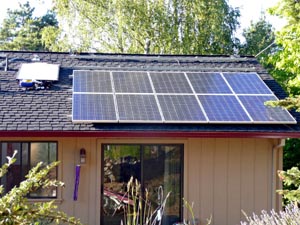 The
federal Investment Tax Credit was expanded and extended
(through 2016) this year, allowing for 30 percent of the
cost of a home renewable energy system to be deducted
from your federal tax bill. Pictured: A home rooftop
solar installation in progress." Photo Credit: ATIS547:
courtesy Flickr
The
federal Investment Tax Credit was expanded and extended
(through 2016) this year, allowing for 30 percent of the
cost of a home renewable energy system to be deducted
from your federal tax bill. Pictured: A home rooftop
solar installation in progress." Photo Credit: ATIS547:
courtesy Flickr


.gif)